Malware Analysis for Beginners — Complete Tutorial 2026
Every day, over 560,000 new malware samples are discovered worldwide. From ransomware crippling hospitals to spyware stealing banking credentials — malware is the #1 weapon of cybercriminals in 2026.
But here's the good news: someone has to fight back. And that someone could be you.
Malware analysis is the art of dissecting malicious software to understand what it does, how it works, and how to stop it. It's one of the most rewarding (and well-paid) skills in cybersecurity.
In this complete beginner-friendly tutorial, you'll learn:
- What malware analysis is and why it matters
- Different types of malware in 2026
- Static, dynamic, and behavioral analysis explained
- How to build a safe malware analysis lab (free)
- Top tools used by professional analysts
- Step-by-step walkthrough of a real sample
- How to extract IOCs (Indicators of Compromise)
- Career path and salary expectations
By the end, you'll be ready to start analyzing your first malware sample safely. 🦠

1. What is Malware Analysis?
Malware analysis is the process of studying malicious software (viruses, trojans, ransomware, spyware, etc.) to understand:
- 🎯 What it does (its behavior)
- 🛠 How it works (its code)
- 🌍 Who created it (attribution)
- 🛡 How to detect and stop it
It's the foundation of incident response, threat intelligence, and detection engineering.
Why Malware Analysis Matters in 2026
- 🚀 AI-generated malware is exploding — new variants daily
- 💰 Ransomware payouts crossed $2 billion in 2025
- 🏢 Every SOC needs analysts who can dissect threats
- 🧠 It's a rare and highly paid skill ($90K–$200K+)
- 🌍 Critical for fighting nation-state APT groups
2. Types of Malware You'll Encounter
Before analyzing malware, know what you're dealing with:
Self-replicating code that attaches to legitimate files.
Malware disguised as legitimate software (e.g., fake "Adobe installer").
Encrypts files and demands payment. Examples: LockBit, BlackCat, Akira.
Secretly monitors user activity (keystrokes, screens, microphones).
Networks of infected machines controlled remotely. Examples: Emotet, Qakbot.
Self-spreading malware that doesn't need user interaction. Example: WannaCry.
Hide deep in the OS to maintain persistent, stealthy access.
Small malware that downloads bigger payloads. Examples: SmokeLoader, IcedID.
Steal browser passwords, cookies, crypto wallets. Examples: RedLine, Lumma, Vidar.
Give attackers full control. Examples: AsyncRAT, Remcos, NjRAT.
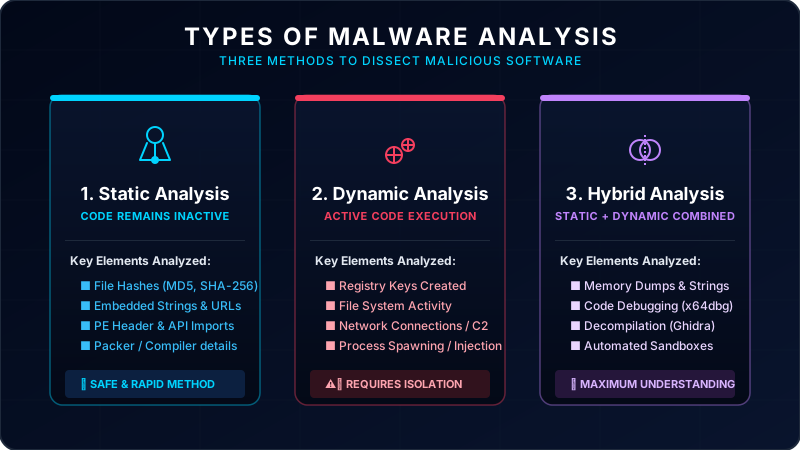
3. The 3 Types of Malware Analysis
There are 3 main approaches to analyzing malware:
🔬 1. Static Analysis
Examines the malware without running it.
What you check:
- File hashes (MD5, SHA-256)
- File type and architecture
- Strings (URLs, IPs, commands)
- Imports/exports (DLLs, APIs)
- PE header information
- Embedded resources
Pros: Safe, fast
Cons: Can be defeated by obfuscation/packing
🏃 2. Dynamic Analysis
Runs the malware in a controlled environment to observe behavior.
What you observe:
- Files created/modified
- Registry changes
- Network connections
- Processes spawned
- Persistence mechanisms
Pros: Reveals real behavior
Cons: Risky if not properly isolated
🧪 3. Hybrid Analysis
Combines both static + dynamic for complete understanding. Sometimes includes code (reverse) analysis using disassemblers like Ghidra or IDA Pro to read the actual code logic.
4. Safety First — Critical Rules Before You Start
⚠️ MALWARE IS DANGEROUS. Follow these rules ALWAYS:
- Never analyze malware on your main machine
- Always use an isolated VM (VirtualBox/VMware)
- Disconnect from your network during dynamic analysis (or use isolated lab network)
- Take snapshots of your VM before running malware (so you can restore)
- Disable shared folders between host and VM
- Never store sensitive data on your analysis machine
- Use a dedicated lab network with no access to production systems
- Don't double-click suspicious files outside the lab — ever
5. Building Your Free Malware Analysis Lab
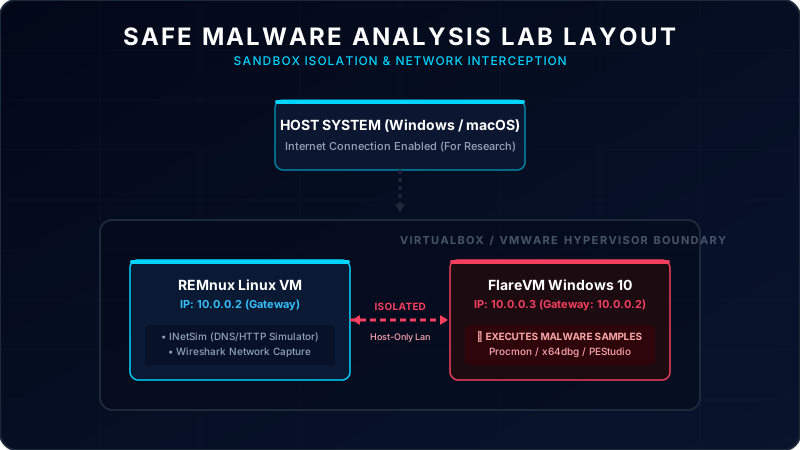
Here's your home lab setup (100% free):
🖥 Step 1: Virtualization
Download and install VirtualBox (free) or VMware Workstation Player.
🐧 Step 2: REMnux (Linux Analysis VM)
A free Linux distro pre-loaded with 100+ malware analysis tools.
Download: remnux.org
🪟 Step 3: FlareVM (Windows Analysis VM)
A free Windows-based malware analysis environment by Mandiant.
Download: github.com/mandiant/flare-vm
🌐 Step 4: INetSim (Internet Simulator)
Fake DNS, HTTP, FTP servers so malware "thinks" it's online but stays isolated. Comes pre-installed with REMnux.
📡 Step 5: Wireshark
For capturing and analyzing malware network traffic.
🔄 Step 6: Snapshot Everything
Before running any sample → take a VM snapshot. Restore after analysis.
6. Where to Get Safe Malware Samples
- MalwareBazaar — bazaar.abuse.ch (free, requires account)
- VirusShare — virusshare.com (free, requires invite)
- theZoo — github.com/ytisf/theZoo (educational samples)
- MalShare — malshare.com (free API access)
- Any.Run public submissions — app.any.run/submissions
❌ NEVER download malware from random websites, Telegram channels, or torrents.
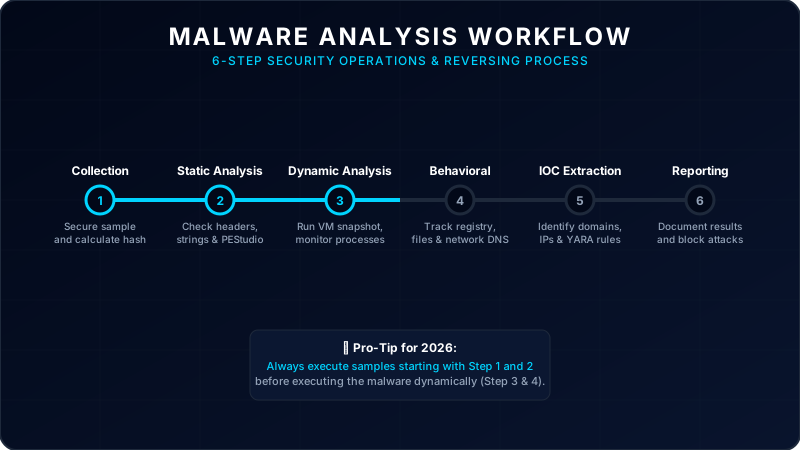
7. The Complete Malware Analysis Workflow
Here's the professional 6-step workflow:
Step 1: Sample Collection & Hashing
Hash the sample (MD5, SHA-256) and search VirusTotal to see if it has been analyzed before.
Step 2: Static Analysis (Basic)
Use tools like PEStudio, Detect It Easy (DIE), and Floss to examine the file structure, import tables, and text strings without running the code.
Step 3: Dynamic Analysis (Behavioral)
Execute the sample inside FlareVM with Procmon, Process Hacker, and network simulation filters running to capture real-time behavior.
Step 4: Code Analysis (Advanced)
Disassemble and debug the binary using Ghidra, IDA, or x64dbg to inspect execution loops and anti-analysis tricks.
Step 5: Extract Indicators of Compromise (IOCs)
Document file paths, hashes, registry changes, mutex identifiers, and C2 server IPs/domains.
Step 6: Reporting
Write up malware behavior summaries, mapping to MITRE ATT&CK techniques, and drafting blocklists or YARA detection signatures.
8. Walkthrough: Analyzing a Simple Malware Sample
Let's walk through analyzing a fake "Invoice.exe" downloader trojan:
🔬 Step 1 — Static Analysis
First, we fetch the SHA-256 hash of the binary:
# Get the hash
sha256sum invoice.exe
# Output: a3f5b2... (check on VirusTotal)
Opening the sample in PEStudio highlights several red flags:
- Compiled in: Visual Studio 2022
- Suspicious API Imports:
WinExec,URLDownloadToFile,CreateRemoteThread - Suspicious Strings:
http://malicious-c2[.]com/payload,cmd.exe /c
🏃 Step 2 — Dynamic Analysis
We take a VM snapshot, launch the trojan, and monitor the system:
- Procmon shows: It creates a file at
%AppData%\Microsoft\update.exe - Regshot reveals: It creates a registry entry under
HKCU\Software\Microsoft\Windows\CurrentVersion\Run\Updaterfor persistence. - Network Logs show: DNS query resolving
malicious-c2[.]com.
🌐 Step 3 — Network Analysis
Wireshark capture records a POST request to /checkin.php carrying system architecture info, followed by downloading a secondary binary from /payload.bin.
📝 Step 4 — IOC Extraction
| Type | Value |
|---|---|
| SHA-256 | a3f5b2... |
| C2 Domain | malicious-c2[.]com |
| File Path | %AppData%\Microsoft\update.exe |
| Registry Key | HKCU\...\Run\Updater |
| Mutex Name | Global\InvoiceUpdater_v1 |
🎯 Step 5 — MITRE ATT&CK Mapping
- T1566.001 — Spearphishing Attachment
- T1204.002 — User Execution: Malicious File
- T1547.001 — Registry Run Key Persistence
- T1071.001 — Web Protocols (C2 Channel)
- T1105 — Ingress Tool Transfer
✅ Now you have everything needed to write detections and block the threat.
9. Top 15 Free Malware Analysis Tools (2026)
| # | Tool | Purpose |
|---|---|---|
| 1 | PEStudio | Static PE file structure analysis & triage |
| 2 | Ghidra | Reverse engineering framework (free, NSA-developed) |
| 3 | IDA Free | Industry-standard disassembler & basic debugger |
| 4 | x64dbg | User-mode x64/x32 assembler debugger |
| 5 | Process Hacker | Process and task monitoring (replaces Task Manager) |
| 6 | Procmon | Registry, File System, and Process thread monitoring |
| 7 | Wireshark | Deep packet inspection and network analysis |
| 8 | Regshot | Registry state comparison before/after execution |
| 9 | Fakenet-NG | Local network services simulator (HTTP/DNS/SMTP) |
| 10 | DIE (Detect It Easy) | Detects packing, compiler signatures, & encryption keys |
| 11 | Floss | Advanced tool for extracting obfuscated and stacked strings |
| 12 | YARA | Pattern matching tool for scanning and classifying files |
| 13 | Cutter | Ghidra-backed modern disassembler GUI interface |
| 14 | Any.Run | Interactive online cloud sandbox sandbox environment |
| 15 | Hybrid Analysis | CrowdStrike-powered multi-sandbox scanning gateway |
10. Online Malware Sandboxes (No Setup Needed)
If you don't want to build a lab, use these free cloud sandboxes for quick triage:
- Any.Run — Highly interactive online sandbox (most popular for threat intelligence)
- Hybrid Analysis — Powered by CrowdStrike, free file submission
- Joe Sandbox — Detailed reports with deep behavioral mappings
- Triage (tria.ge) — Modern API-driven sandbox
- VirusTotal — Fast hash scanning against 70+ antiviruses
- Intezer Analyze — Code genetic sequencing mapping to identify family reuse
- VMRay — Hypervisor-based stealth analysis platform
✅ Perfect for quick triage when you don't have time for full manual analysis.
11. Writing Your First YARA Rule
YARA rules help you classify and detect malware families by specifying text or hexadecimal patterns in a signature file:
rule Suspicious_Downloader {
    meta:
        author = "Hackers in Threat Hunt"
        description = "Detects basic downloader trojan"
        date = "2026-01-15"

    strings:
        $url = "malicious-c2.com" ascii
        $api1 = "URLDownloadToFileA" ascii
        $api2 = "WinExec" ascii
        $mutex = "InvoiceUpdater_v1" wide

    condition:
        2 of ($api*) and ($url or $mutex)
}
This rule fires whenever 2+ suspicious APIs are present in the PE structure AND either the C2 domain or specific mutex string is found. 🎯
12. Career Path in Malware Analysis
🎓 Career Progression & Salary Expectations
- Junior Malware Analyst: $60K–$85K (Entry-level triage)
- Malware Analyst: $90K–$130K (Deep-dives, static & dynamic logs)
- Senior Reverse Engineer: $140K–$200K (Kernel-level code debugging)
- Threat Researcher / RE Lead: $200K+ (APT tracking, custom decryption tools)
🏢 Where to Work
Cybersecurity vendors (CrowdStrike, Mandiant, ESET, Kaspersky), national CERTs, intelligence agencies, threat intelligence providers, and global corporate SOCs.
📜 Recommended Certifications
- GREM (GIAC Reverse Engineering Malware) — The industry gold standard
- eCMAP (eLearnSecurity Certified Malware Analyst) — Highly practical hands-on exam
- PMAT (Practical Malware Analysis & Triage) — Affordable, modern certification by TCM Security
- Zero2Automated — Advanced course for malware reverse engineering
13. Common Beginner Mistakes to Avoid
- ❌ Running malware on your main host computer
- ❌ Forgetting to take a VM snapshot before running the binary
- ❌ Failing to isolate network adapters (host-only configuration)
- ❌ Blindly trusting a single sandbox report
- ❌ Skipping static analysis and executing malware immediately
- ❌ Getting stuck on packing/obfuscation without checking imports first
- ❌ Failing to keep detailed written logs of analysis steps
14. The Future of Malware Analysis (2026 & Beyond)
As we navigate 2026, the malware landscape is changing rapidly:
- 🤖 AI-Powered Analysis: LLMs are being integrated into debuggers to auto-summarize assembly loops in seconds.
- 🧬 Polymorphic AI Malware: Code that mutates dynamically during execution to evade traditional signatures.
- ☁️ Cloud-Targeting Malware: Malware targeting Kubernetes orchestration APIs and serverless resources.
- 🐧 Multi-Platform Detections: Go and Rust-based malware executing seamlessly across Windows, Linux, and macOS.
Analysts who master **classic reverse engineering + AI triage tools** will dominate the defense landscape.
Conclusion
Malware analysis is one of the most exciting and impactful roles in cybersecurity. Every sample you dissect helps protect thousands (sometimes millions) of users.
Remember: malware analysts are digital detectives. Every byte tells a story. Your job is to decode it.
The malware authors keep evolving. So should you. 🔬
👉 Next Step: Read our MITRE ATT&CK Framework Explained to map behaviors, Penetration Testing Guide 2026 for attacker methodologies, and How to Become a SOC Analyst to start your security career.
Frequently Asked Questions (FAQ)
About the Authors
Written by the Hackers in Threat Hunt Team. We are a collaborative force of certified ethical hackers (OSCP, eWPTX, PNPT) specializing in network penetration testing, application security audits, and threat emulation. Our goal is to secure enterprise infrastructure by hacking it first.