Red Team vs Blue Team vs Purple Team Explained (2026 Complete Guide)
In cybersecurity, the battle between attackers and defenders never stops. To win this battle, organizations build specialized teams — Red Teams that attack, Blue Teams that defend, and Purple Teams that bridge the two.
If you're starting in cybersecurity in 2026 — or trying to figure out which career path suits you — understanding these three teams is critical.
In this guide, you'll learn:
- What Red, Blue, and Purple teams actually do
- The skills, tools, and certifications for each
- Day-in-the-life of every role
- Salary expectations worldwide
- Pros and cons of each path
- Which team is right for YOU
- How they work together in real organizations
By the end, you'll know exactly which team to join — and how to get there. 🎯
1. The Origin of Color-Coded Teams
The terms "Red Team" and "Blue Team" come from military war games, where one team simulated enemy forces (Red) and the other defended (Blue).
The cybersecurity industry adopted this in the early 2000s. As teams realized that pure offense vs. defense wasn't enough, the concept of a Purple Team emerged — a hybrid that combines both for better collaboration and learning.
The Modern Color Spectrum
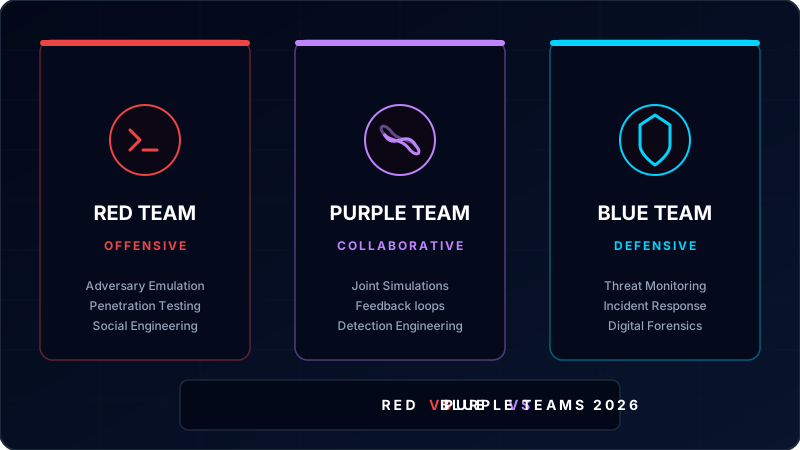
- Red Team — Offensive (attackers)
- Blue Team — Defensive (defenders)
- Purple Team — Collaborative (both)
- White Team — Referees / management
- Green Team — Builders (DevSecOps)
- Yellow Team — Developers
But the big 3 (Red, Blue, Purple) are the ones that matter most.
2. What is a Red Team?
The Red Team is the offensive side of cybersecurity. Their job is to think and act like real attackers — using the same tools, techniques, and tactics (TTPs) as cybercriminals and nation-state APTs.
🎯 Red Team Mission
Simulate real-world attacks to identify weaknesses before bad guys do.
🛠 What Red Teamers Do Daily
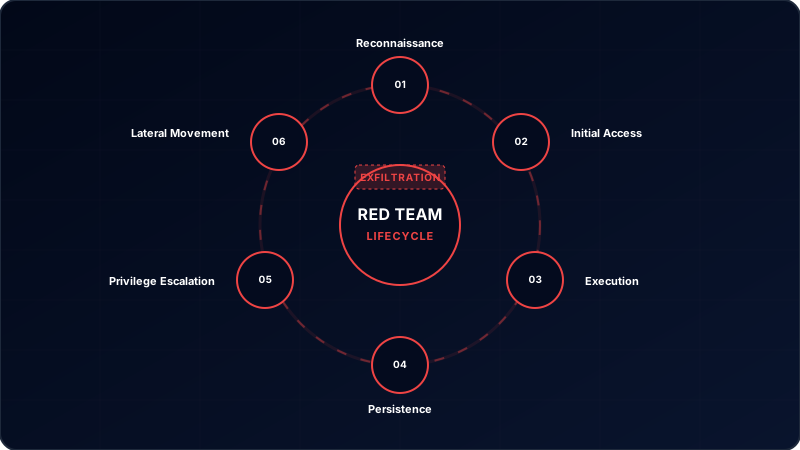
- Reconnaissance and OSINT on targets
- Phishing campaigns to test employees
- Exploit vulnerabilities in apps, networks, and cloud
- Lateral movement and privilege escalation
- Achieve specific objectives ("flags") like accessing executive emails
- Write detailed reports for the blue team to improve
🧠 Red Team Skills
- Penetration testing methodologies
- Active Directory exploitation
- Web app hacking (OWASP Top 10)
- Social engineering
- Custom payload development
- C2 frameworks (Cobalt Strike, Sliver, Havoc)
- Programming (Python, PowerShell, C#)
- Cloud attack techniques (AWS, Azure, GCP)
🔧 Top Red Team Tools
💼 Red Team Roles
Penetration Tester, Red Team Operator, Red Team Lead, and Adversary Emulation Specialist.
💰 Red Team Salaries (2026)
| Role | USA | India |
|---|---|---|
| Junior Pentester | $65K–$90K | ₹6–10 LPA |
| Red Team Operator | $110K–$160K | ₹15–30 LPA |
| Senior Red Teamer | $160K–$220K+ | ₹30–60 LPA |
📜 Best Red Team Certifications
OSCP (Penetration testing gold standard), CRTP (Active Directory), CRTO (Red team operations), OSEP (Evasion and breaching), and PNPT (Practical pentest).
3. What is a Blue Team?
The Blue Team is the defensive side of cybersecurity. They are the guardians — monitoring networks, hunting threats, responding to incidents, and stopping attacks 24/7.
🛡 Blue Team Mission
Detect, defend, and respond to cyber threats in real time.
🛠 What Blue Teamers Do Daily
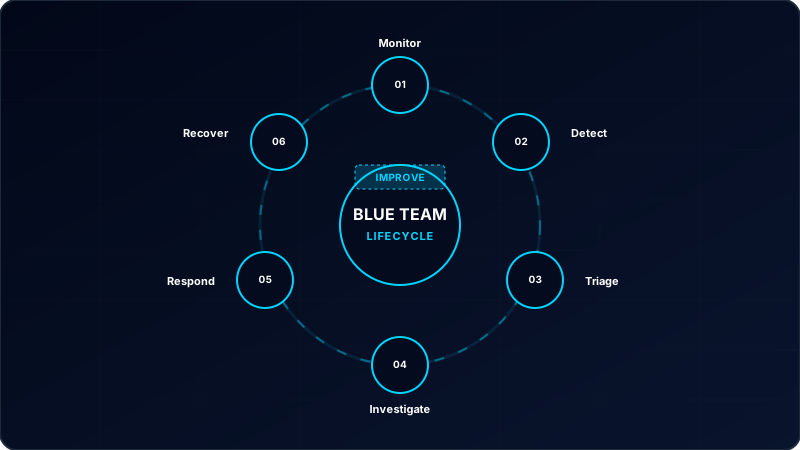
- Monitor SIEM dashboards for alerts
- Investigate suspicious activities
- Respond to incidents and breaches
- Analyze malware and phishing emails
- Tune detection rules and reduce false positives
- Hunt for hidden threats (threat hunting)
- Conduct digital forensics
- Document incidents and lessons learned
🧠 Blue Team Skills
- Log analysis and SIEM operations
- Network and endpoint monitoring
- Incident response and forensics
- Malware analysis basics
- Threat intelligence
- Scripting (Python, PowerShell)
- MITRE ATT&CK framework
- Cloud security monitoring
🔧 Top Blue Team Tools
💼 Blue Team Roles
SOC Analyst (T1, T2, T3), Incident Responder, Threat Hunter, Digital Forensics Analyst, Detection Engineer, and Malware Analyst.
💰 Blue Team Salaries (2026)
| Role | USA | India |
|---|---|---|
| SOC Analyst (Tier 1) | $60K–$85K | ₹4–8 LPA |
| Incident Responder | $95K–$130K | ₹10–20 LPA |
| Threat Hunter | $120K–$170K | ₹18–35 LPA |
| Senior Blue Team Lead | $150K–$200K+ | ₹30–50 LPA |
📜 Best Blue Team Certifications
CompTIA Security+ (Foundational must-have), CompTIA CySA+ (SOC and analytics), Blue Team Level 1 (BTL1) (Practical defense), GCIH (Incident handling), and Microsoft SC-200.
4. What is a Purple Team?
The Purple Team isn't really a separate team in most companies — it's a collaborative function where Red and Blue teams work together to improve security continuously.
🟣 Purple Team Mission
Bridge the gap between offense and defense to maximize detection and response capabilities.
🛠 What Purple Teamers Do
- Run controlled attack simulations
- Validate detection coverage in real-time
- Tune SIEM rules based on attack telemetry
- Share knowledge between Red and Blue
- Train Blue Team on attacker techniques
- Test new detections against known TTPs
- Build MITRE ATT&CK coverage matrices
🧠 Purple Team Skills
- Strong understanding of BOTH offense and defense
- Adversary emulation (Atomic Red Team, Caldera)
- Detection engineering
- MITRE ATT&CK expertise
- Communication and collaboration
- SIEM and EDR knowledge
- Threat intelligence integration
🔧 Top Purple Team Tools

💼 Purple Team Roles
Purple Team Engineer, Detection Engineer, Adversary Emulation Specialist, and Security Validation Engineer.
💰 Purple Team Salaries (2026)
| Role | USA | India |
|---|---|---|
| Purple Team Engineer | $110K–$160K | ₹14–28 LPA |
| Detection Engineer | $120K–$180K | ₹16–32 LPA |
| Senior Purple Team Lead | $160K–$220K+ | ₹28–55 LPA |
📜 Best Purple Team Certifications
CRTO (Red Team Operator) for offensive knowledge, BTL2 (Blue Team Level 2) for defense, GCDA for continuous monitoring, and combinations like PNPT + GCFA.
5. Red vs Blue vs Purple — Side-by-Side Comparison
| Aspect | 🔴 Red Team | 🔵 Blue Team | 🟣 Purple Team |
|---|---|---|---|
| Mission | Attack & exploit | Defend & detect | Collaborate & improve |
| Mindset | "How can I break in?" | "How can I stop them?" | "How can we work together?" |
| Skills | Offensive hacking | Monitoring, IR | Both + collaboration |
| Tools | Cobalt Strike, Burp | Splunk, EDR | Atomic Red Team, Caldera |
| Output | Pentest reports | Incident reports | Detection tuning |
| Personality | Creative, curious | Patient, analytical | Communicative, balanced |
| Salary Range | $65K–$220K+ | $60K–$200K+ | $110K–$220K+ |
| Job Demand 2026 | High | Very High | Growing Rapidly |
6. How Red, Blue & Purple Teams Work Together
In modern organizations, these teams operate in a continuous feedback loop:
🔁 The Cycle
- 🔴 Red Team attacks → Simulates real-world adversary
- 🔵 Blue Team detects (or fails to)
- 🟣 Purple Team analyzes gaps → "Why didn't we detect this?"
- 🔧 Blue Team **builds new detections**
- 🔴 Red Team **tests detections** → "Can we bypass these?"
- 🔁 Repeat continuously
🎯 Real-World Example
Scenario: Red Team launches a phishing campaign with a malicious Excel macro.
- 🔴 Red Team uses Cobalt Strike to gain initial access
- 🔵 Blue Team detects PowerShell child process via Sysmon
- 🟣 Purple Team meets to discuss: "We caught the execution but missed the email. Why?"
- 🔧 Blue Team builds new email gateway rules
- 🔴 Red Team retests with different payload — defenses improve

7. Which Team is Right for YOU?
Pick based on your personality and interests:
🔴 Red Team if you:
- ✅ Love breaking things
- ✅ Enjoy puzzles & CTFs
- ✅ Handle constant learning
- ✅ Don't mind irregular hours
🔵 Blue Team if you:
- ✅ Are patient & analytical
- ✅ Enjoy threat hunting
- ✅ Stay calm under pressure
- ✅ Like building structures
🟣 Purple Team if you:
- ✅ Know both attack/defense
- ✅ Love teaching & collab
- ✅ Think big-picture strategic
- ✅ Are a strong communicator
💡 Pro Tip: Most people start in Blue Team (easier entry), move to Red Team after 2–3 years, and eventually grow into Purple Team roles.
8. Career Progression Paths
9. Pros and Cons of Each Team
- Exciting, creative work
- High salary potential
- On-site breach testing
- Industry recognition
- Irregular engagement hours
- Constant skill updates
- Harder entry barrier
- Heavy report documentation
- Abundant jobs available
- Structured shifts
- Easier entry for beginners
- Corporate security stability
- Alert fatigue risk
- 24/7 SOC shift requirements
- Repetitive lower-tier tasks
- Slightly lower starting pay
- Strategic high-impact work
- Excellent compensation
- Cross-team operations
- Fast tracking to management
- Requires deep dual experience
- Fewer standalone roles
- Heavy meeting schedules
- Difficult performance metrics
10. Common Misconceptions
❌ "Red Team is cooler than Blue Team"
✅ Both are equally important. Blue Team has WAY more jobs and impacts more systems daily.
❌ "Purple Team is a separate job everywhere"
✅ In most companies, Purple Team is a *function* performed by Red + Blue collaborating.
❌ "You need to choose one forever"
✅ Many pros switch sides or do both throughout their careers.
❌ "Red Team makes more money"
✅ Senior Blue Team and Purple Team roles can pay just as much (or more).
❌ "Blue Team is boring"
✅ Threat hunting, malware analysis, and IR are some of the most exciting jobs in cyber.
11. Building Skills for Each Team (Free Resources)
- TryHackMe — Offensive Pentesting path
- HackTheBox — Active machines
- PortSwigger Academy — Web pentesting
- OffSec Proving Grounds — OSCP-style boxes
- PicoCTF — Beginner CTFs
- LetsDefend.io — Real SOC simulations
- CyberDefenders.org — Blue team labs
- BlueTeamLabs.online — Hands-on challenges
- TryHackMe SOC Level 1 & 2 — Structured path
- Splunk BOTS — Free CTF-style data
- Atomic Red Team — Run + detect attacks
- MITRE Caldera — Adversary emulation
- DetectionLab — Pre-built purple lab
- SimuLand — Microsoft's attack simulation
- VECTR — Purple team management
12. The Future of Red, Blue & Purple Teams (2026 & Beyond)
The winners in 2026 will be teams that collaborate, automate, and adapt faster than attackers. Look out for these trends:
- 🚀 AI-Augmented Teams — All three teams using LLMs to accelerate work
- 🚀 Continuous Adversary Emulation — Always-on purple team testing
- 🚀 Cloud-Native Operations — More cloud attacks and defenses
- 🚀 Automated Detection Engineering — AI generating Sigma rules
- 🚀 Crowdsourced Red Teaming — Bug bounty + red team merging
- 🚀 Identity-Centric Defense — Blue teams focus on identity over network
Conclusion
Red, Blue, and Purple Teams are the three pillars of modern cybersecurity. Whether you want to attack like a hacker, defend like a guardian, or bridge both worlds — there's a path for you.
The most important thing? Start somewhere. Pick the team that excites you most, learn the tools, get certified, build a home lab, and start practicing today.
👉 Next Step: Read our How to Become a SOC Analyst 2026 for the blue team path, Penetration Testing Guide 2026 for the red team path, and Top 10 Cybersecurity Certifications 2026 to plan your certifications.
About the Author
Written by the Hackers in Threat Hunt Team, a collective of active red team operators, SOC analysts, and security leaders dedicated to defensive and offensive cyber education.