Top 15 Free OSINT Tools Every Hacker Must Know in 2026
In the world of cybersecurity, information is power — and that's exactly what OSINT (Open Source Intelligence) delivers. Whether you're a penetration tester, threat hunter, bug bounty hunter, or SOC analyst, mastering OSINT tools is one of the most valuable skills you can build in 2026.
OSINT allows you to gather intelligence about people, organizations, domains, IP addresses, social media accounts, leaked credentials, and even dark web activity — all using publicly available data.
In this guide, you'll learn:
- What OSINT is and why it matters in 2026
- The OSINT framework and methodology
- Top 15 free OSINT tools every hacker must know
- Real-world use cases for each tool
- How to build your own OSINT workflow
Let's dive in. 🔍

1. What is OSINT?
OSINT (Open Source Intelligence) is the process of collecting and analyzing publicly available information from open sources like websites, social media, search engines, public databases, and forums.
Unlike hacking into private systems, OSINT relies entirely on legal, public data — making it a critical skill for ethical hackers, investigators, journalists, and law enforcement.
Why OSINT is Critical in 2026
- 🌐 Over 5.5 billion people use the internet daily — leaving huge digital footprints
- 🕵️ 90% of intelligence used by agencies comes from open sources
- 🎯 First phase of every pentest and red team engagement
- 💼 High demand: OSINT analysts earn $70K–$150K+ annually
2. The OSINT Framework
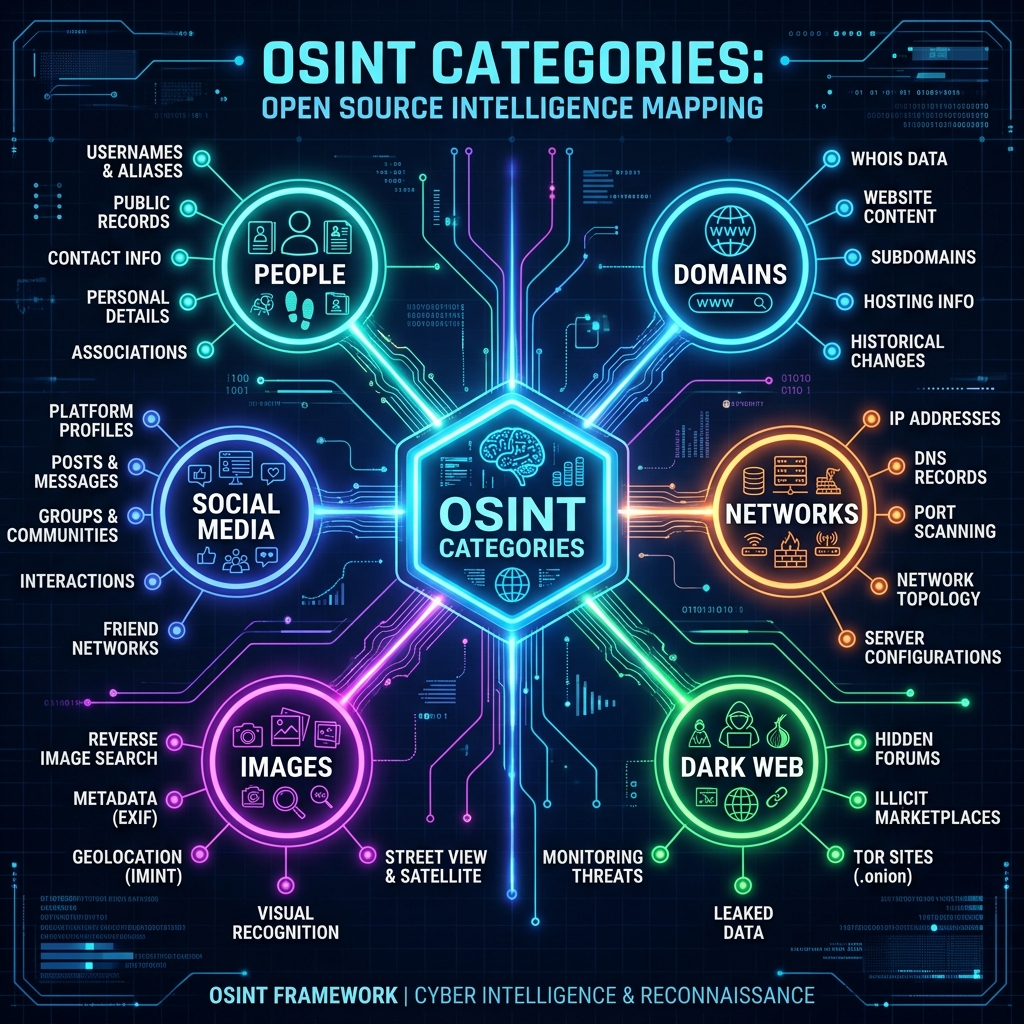
Before using tools, understand the OSINT categories:
- People OSINT — usernames, emails, phone numbers, social profiles
- Domain & DNS OSINT — websites, subdomains, WHOIS data
- Network OSINT — IPs, open ports, exposed services
- Social Media OSINT (SOCMINT) — profiles, posts, connections
- Image & Video OSINT — reverse image search, geolocation
- Dark Web OSINT — leaked data, threat actor activity
- Geospatial OSINT (GEOINT) — maps, satellite imagery
3. Top 15 Free OSINT Tools in 2026
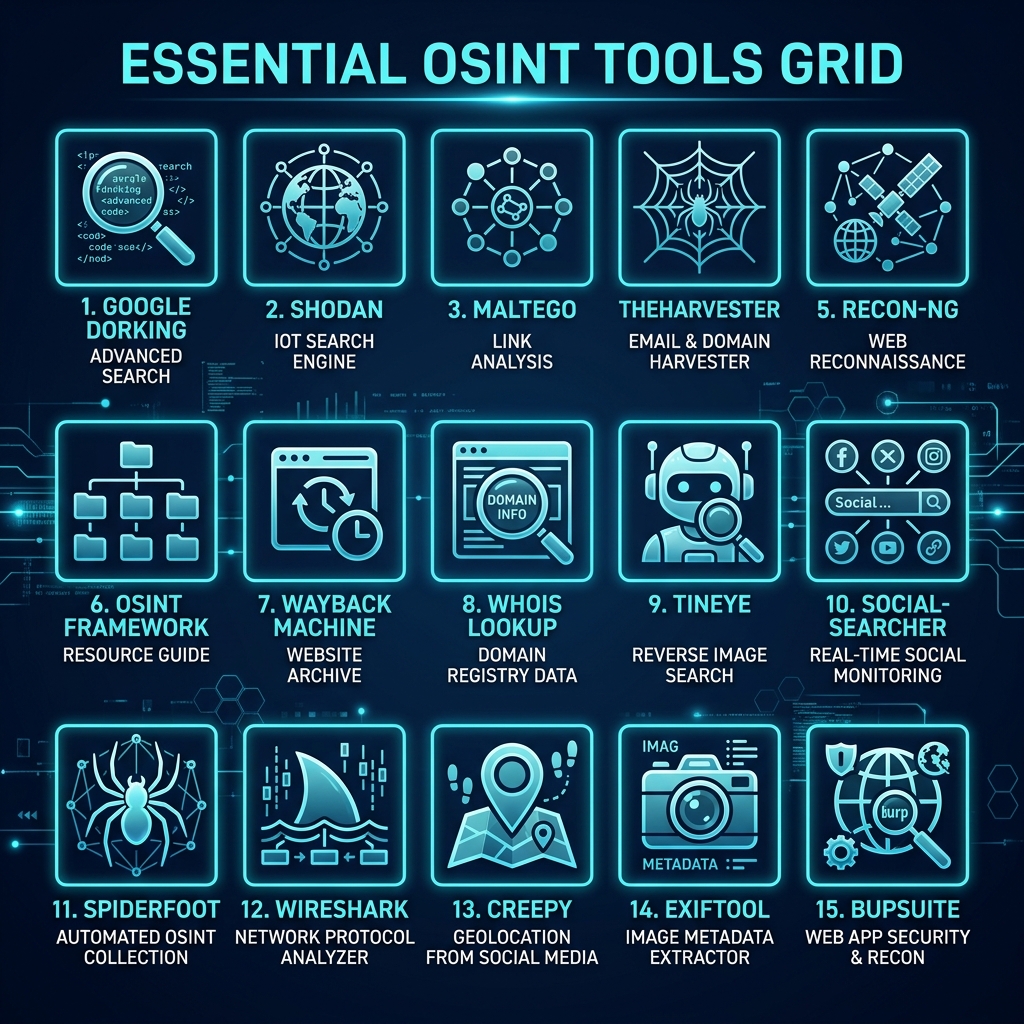
Here's the ultimate list of free OSINT tools every hacker must master:
🔍 1. Maltego (Community Edition)
Category: All-in-one OSINT
Use Case: Visual link analysis between people, domains, emails, and infrastructure.
Why It's Great: Drag-and-drop "transforms" to map relationships instantly.
🔍 2. Shodan
Category: Network OSINT
Use Case: The "Google for hackers" — finds internet-connected devices, servers, IoT, webcams, ICS systems.
Why It's Great: Discover exposed databases, RDP, and misconfigured servers worldwide.
🔍 3. theHarvester
Category: Email & Subdomain OSINT
Use Case: Gathers emails, names, subdomains, and IPs from public sources like Google, Bing, LinkedIn.
Why It's Great: Pre-installed in Kali Linux. Perfect for recon phase.
theHarvester -d target.com -b all
🔍 4. Recon-ng
Category: Full Recon Framework
Use Case: Modular reconnaissance framework with a Metasploit-like interface.
Why It's Great: Automates OSINT data collection with 80+ modules.
🔍 5. SpiderFoot
Category: Automated OSINT
Use Case: Automates intelligence gathering across 200+ data sources.
Why It's Great: Free open-source version available; great for asset discovery.
🔍 6. Sherlock
Category: Username OSINT
Use Case: Hunts down a username across 400+ social networks in seconds.
Why It's Great: Lightweight Python tool, perfect for identity investigations.
sherlock username
🔍 7. Holehe
Category: Email OSINT
Use Case: Checks if an email is registered on 120+ websites (Instagram, Twitter, etc.).
Why It's Great: Useful for account enumeration without sending password resets.
🔍 8. Google Dorks
Category: Search Engine OSINT
Use Case: Advanced Google search queries to find hidden files, exposed credentials, vulnerable sites.
Why It's Great: Completely free, requires zero installation.
site:target.com filetype:pdf "confidential"
🔍 9. Wayback Machine
Category: Historical OSINT
Use Case: Access archived versions of websites going back 20+ years.
Why It's Great: Find deleted pages, old subdomains, leaked endpoints.
🔍 10. Hunter.io
Category: Email Discovery
Use Case: Finds email addresses associated with a domain.
Why It's Great: Free tier available; great for OSINT and lead generation.
🔍 11. Have I Been Pwned (HIBP)
Category: Breach Data OSINT
Use Case: Check if an email or password appeared in known data breaches.
Why It's Great: Free API and web interface; essential for credential checks.
🔍 12. OSINT Framework
Category: Tool Directory
Use Case: A massive visual directory of every OSINT tool by category.
Why It's Great: Your one-stop bookmark for any OSINT investigation.
🔍 13. Amass
Category: Subdomain Enumeration
Use Case: Discovers subdomains, ASN data, and external infrastructure mapping.
Why It's Great: Used by bug bounty hunters worldwide. Built by OWASP.
amass enum -d target.com
🔍 14. ExifTool
Category: Metadata OSINT
Use Case: Extracts hidden metadata (GPS, device info, author) from images, PDFs, documents.
Why It's Great: Reveals creator identity and location from any file.
exiftool image.jpg
🔍 15. GHunt
Category: Google Account OSINT
Use Case: Investigates Google accounts to find associated emails, YouTube channels, reviews, and locations.
Why It's Great: Modern, actively maintained, perfect for people-focused OSINT.
4. Bonus: Underrated OSINT Tools
A few extra tools worth bookmarking:
- Censys — Alternative to Shodan with deeper TLS data
- IntelX — Search engine for leaked data and dark web
- Epieos — Email and phone reverse lookup
- PhoneInfoga — Phone number investigation
- Social Searcher — Real-time social media search
5. Building Your OSINT Workflow
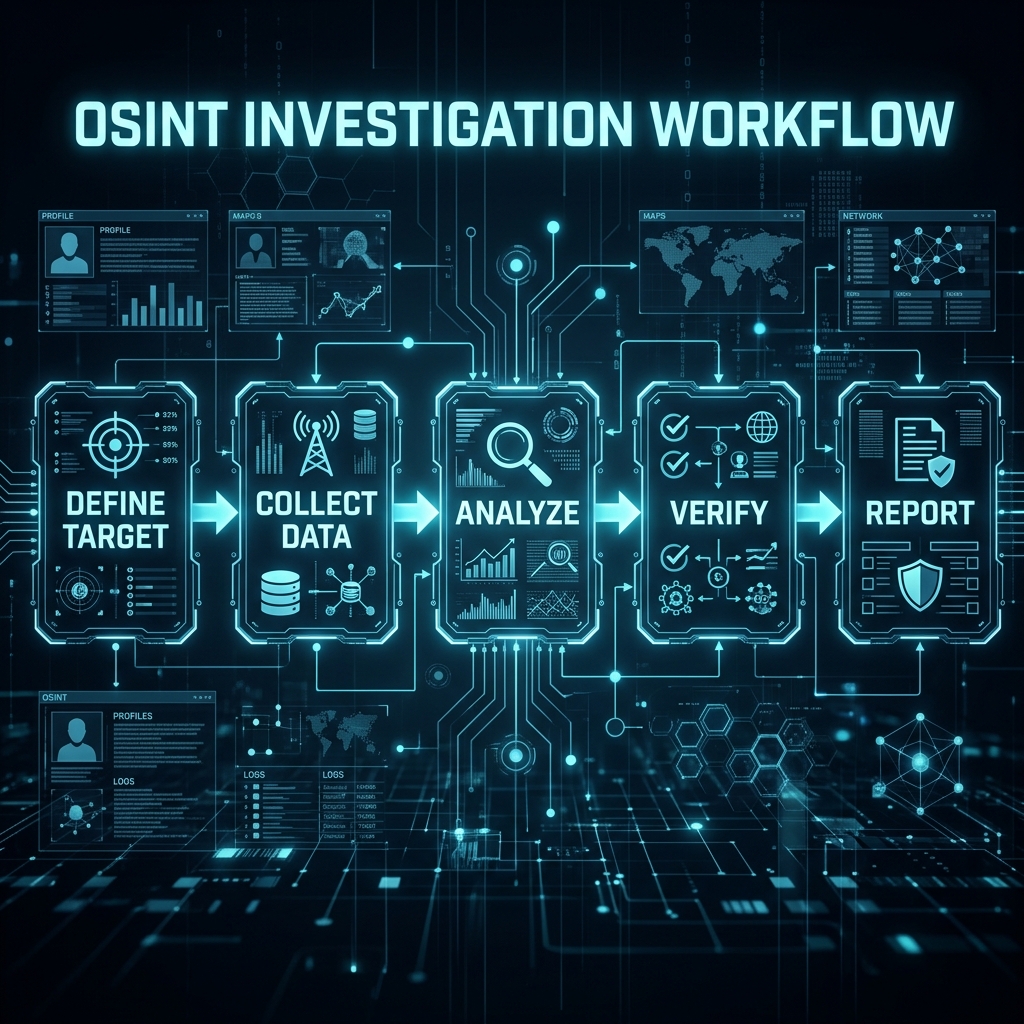
Follow this 5-step process for every investigation:
Step 1: Define Your Target
What are you investigating? Person, domain, company, or incident?
Step 2: Collect Data
Use multiple tools across different categories (don't rely on just one).
Step 3: Analyze & Correlate
Connect data points using Maltego or visual mapping.
Step 4: Verify
Cross-check information from multiple sources to avoid false positives.
Step 5: Document & Report
Create a clean report with screenshots, timestamps, and sources.
6. Real-World OSINT Use Cases
OSINT isn't just for hackers. It's used by:
- 🛡 Pentesters — Recon phase of engagements
- 🐛 Bug Bounty Hunters — Finding subdomains and exposed assets
- 🕵️ Investigators — Locating missing persons or scammers
- 🧠 Threat Hunters — Tracking APT groups and infrastructure
- 📰 Journalists — Verifying sources and exposing fraud
- 🏢 Corporate Security — Brand monitoring and leak detection
7. OSINT Best Practices (Stay Legal & Anonymous)
- ✅ Use a VPN — Mask your real IP during investigations
- ✅ Use a sock puppet account — Never use your personal social accounts
- ✅ Use a VM — Isolate your OSINT environment (Trace Labs OSINT VM is great)
- ✅ Stick to public data — Never log in to private accounts
- ✅ Respect privacy laws — GDPR and local laws apply
- ✅ Document your sources — Always cite where data came from
8. Common OSINT Mistakes to Avoid
- ❌ Using your real identity during investigations
- ❌ Relying only on one tool or source
- ❌ Skipping the verification step
- ❌ Ignoring metadata in images and documents
- ❌ Forgetting to check the Wayback Machine
- ❌ Not staying updated with new tools
9. The Future of OSINT in 2026 & Beyond
- 🚀 AI-powered OSINT — Tools like ChatGPT and Claude help summarize and correlate data faster.
- 🚀 Automated dark web monitoring — Real-time alerts for leaked credentials.
- 🚀 Geospatial AI — Auto-identifying locations from photos using AI.
- 🚀 Deepfake detection — New OSINT tools to verify image/video authenticity.
The OSINT analysts who combine traditional skills + AI tools will dominate 2026.
Conclusion
OSINT is one of the most powerful and underrated skills in cybersecurity. The 15 tools listed in this guide will give you everything you need to start gathering intelligence like a pro — whether you're hunting bugs, investigating threats, or doing red team recon.
The best part? They're all free. Start with 2–3 tools, master them, then expand your arsenal. The more you practice, the sharper your OSINT instincts will become.
👉 Next Step: Read our Penetration Testing Guide 2026 to learn how OSINT fits into the full pentesting workflow.
Frequently Asked Questions (FAQ)
About the Authors
Written by the Hackers in Threat Hunt Team. We are a collaborative force of certified ethical hackers (OSCP, eWPTX, PNPT) specializing in network penetration testing, application security audits, and threat emulation. Our goal is to secure enterprise infrastructure by hacking it first.